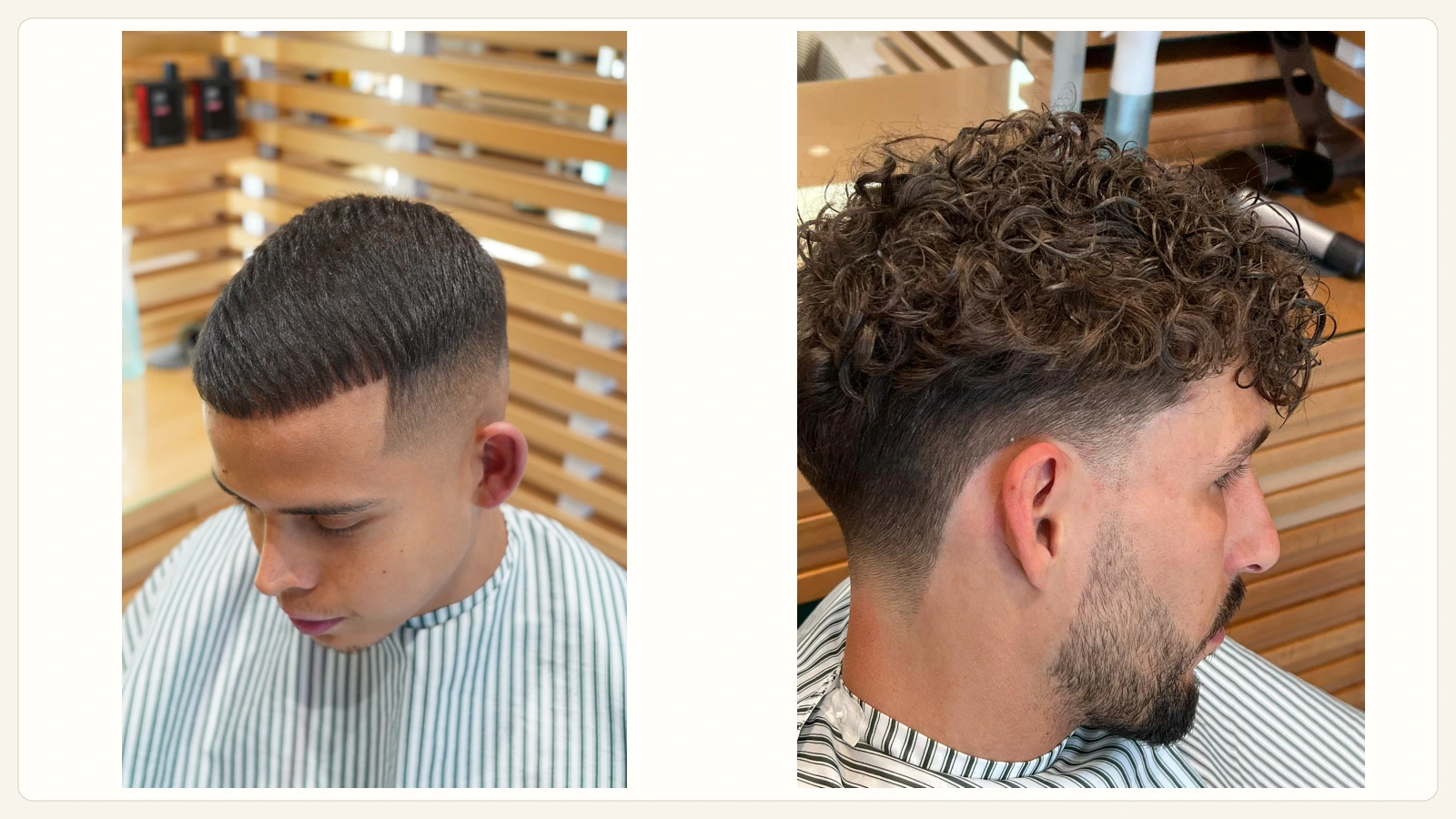
A fringe is the front section of hair worn onto the forehead or parted around it. Choose a short forward crop, a textured fringe, a side sweep, curtains or a curly fringe by how you want that section to fall. Then decide on the sides separately: a fringe can go with a fade, a taper or longer scissor-cut sides.
The useful question is where the front should sit when dry. A straight edge, separated pieces and a centre opening can look very different at a similar length. Bring a reference with hair that falls like yours, and point out the part you want to copy.
Five fringe shapes at a glance
| Front shape | What you see | What to agree before cutting |
|---|---|---|
| Short forward crop | A short fringe directed forward, often with a defined edge | Its dry position on the forehead and how blunt the edge should be |
| Textured fringe | Visible separation and movement in the front | A broken or solid edge, and how much coverage to keep |
| Side-swept fringe | Hair crossing the forehead towards one side | Which direction it falls and whether you use a dryer |
| Curtain fringe | Two front sections opening around a parting | Where the part sits and the length of each side |
| Curly or wavy fringe | Curls or waves falling towards the forehead | The resting length of the dry curl, without stretching it |
These choices overlap. A crop can be textured, and a curtain fringe can be wavy. Use the description to settle the result rather than treating every name as a different haircut.
Short forward crop: French crop and Caesar
A crop directs the top forwards and finishes with a short fringe. French crop and Caesar are familiar names in this family, but their use overlaps. Uppercut Deluxe uses both names for a forward crop. Show the length and edge you mean instead of assuming the name sets them precisely.
A blunt edge gives a clear line across the front; a softer edge breaks into smaller pieces. Ask for the fringe to be checked dry before the final shortening. If you like a compact crop but dislike a very high front line, say so before the sides are cut.
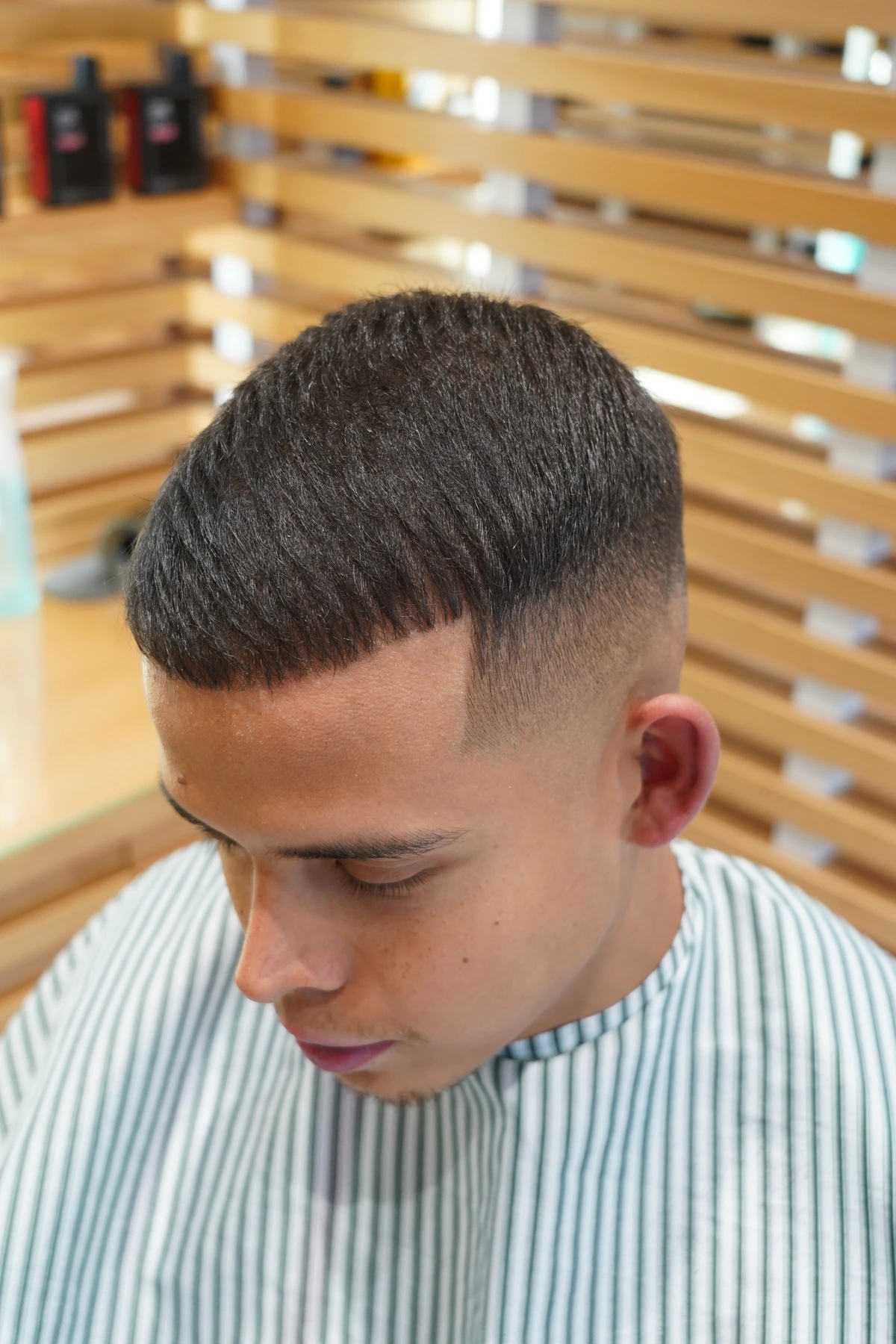
Textured fringe: movement at the front
Texture means visible separation and movement in the hair. It does not automatically mean a jagged fringe: a textured top can still finish with a blunt edge. Decide whether you want individual front pieces or a more continuous line.
Ask your barber to keep enough coverage for the shape you like and to explain any weight removal. If your front is fine, removing more hair is not the same as creating a fuller-looking fringe. For the difference between strand thickness, curl and density, see our hair-type guide.
Side-swept fringe: choose the direction
A side sweep takes the front across the forehead towards one side. It can have a clear parting or a looser finish. Unlike hair lifted into a quiff, the fringe still travels across the front.
Tell your barber which way you normally wear it and whether you are willing to dry it into place. A hairline cowlick can push it away from your preferred direction. Try the movement before shortening the section that needs to reach across.
Curtain fringe: an opening at the centre
Curtains split the front into two sections around a parting, usually central or slightly off centre. The ends fall to either side rather than making one line across the forehead. The sides of the haircut can remain soft or be cut shorter.
Ask where the part will sit and how the front will join the rest of the top. Show whether you want the opening narrow or broad. If you are growing a short crop towards curtains, agree which front lengths to leave while the rest is tidied.
Curly or wavy fringe: judge the dry fall
A curly fringe uses the curl or wave at the front rather than pulling it into a straight line. It may also be a crop or a parted shape. Look at where the curls rest once dry, because wet or stretched hair can appear longer.
Ask for the final front length to be checked in its natural fall, without pulling the curl straight. Leave room to refine the shape after drying instead of agreeing a wet length alone. Our curly-haircut guide covers the rest of the cut and curl styling.
What to tell your barber
Start with the front, then talk about the sides. “A textured fringe with a fade” leaves important decisions open. A clearer brief is: “Keep the front falling forward, soften the edge and show me where it will sit when dry. Keep the fade low and leave some weight at the temples.”
- Length: point to where you want the dry fringe to sit.
- Edge: choose a solid line or separated pieces.
- Direction: forward, to one side or parted.
- Routine: say whether you air-dry, blow-dry or use product.
Show your barber where you want the fringe to sit when it is dry. Before making it shorter, check which way the front grows and how it falls without being pulled straight.
If you have a cowlick, show it before the front is combed into a temporary shape. For the sides, use our fade guide to discuss the height and finish.
Styling without loading the front with product
Set the direction while drying, then assess the shape. For a forward crop, Uppercut’s styling guide directs the hair forward with medium-low heat and finishes by separating pieces with the fingers. Follow the directions for the product you use and start with a small amount.
Distribute a paste or cream through your hands before applying it, so the whole dose does not land on one front section. With curls, follow your usual curl routine and check how the fringe falls after drying. Ask your barber to show a finish you can repeat at home.
Two common fringe questions
Can I have a fringe with a cowlick?
It depends on where it is and which way the front grows. The fringe may need a different direction, more length or more styling than the reference. Discuss the front in its natural position; our unmanageable-hair guide covers growth patterns in more detail.
How often does a fringe need trimming?
Use the shape as your signal. A precise crop changes when the edge loses its line; a longer fringe may bother you when it reaches your eyes or no longer parts easily. Agree what to tidy while keeping the rest of the length you want.
Bring your reference to your next haircut and settle the dry front length first. If you want to keep growing the front, our long-hair guide explains how to discuss trimming while retaining length.
Shape and cutting guidance checked against primary sources: Uppercut Deluxe’s natural crop and textured crop, Schwarzkopf’s curtain fringe guide, and ARC Scissors’ dry-cutting fringe advice.
Community
Join the conversation
Share your thoughts or ask a question. Our barbers are listening.